Driving change
For millions of commuters, losing hours to traffic is a daily frustration. For Tamara Ivancovic (BEng Aerospace, Aeronautical and Astronautical Engineering, 2023), it became a provocation. A challenge to solve.
While on placement with AlphaTauri Formula One, working in aerodynamic design, Tamara found herself crawling through seven miles of traffic each day.
“I should have been cycling,” she says. “Instead, I was stuck in a car, wasting time. I kept thinking that only around four per cent of people in the UK cycle to work. Why? And what could I build that would genuinely help people make that shift?”
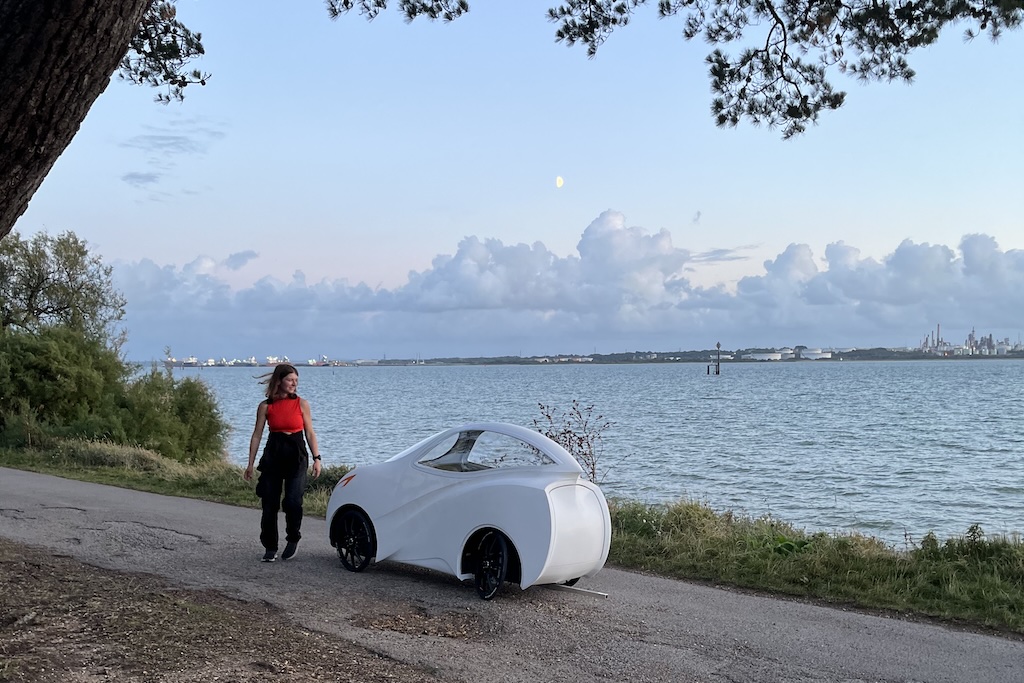
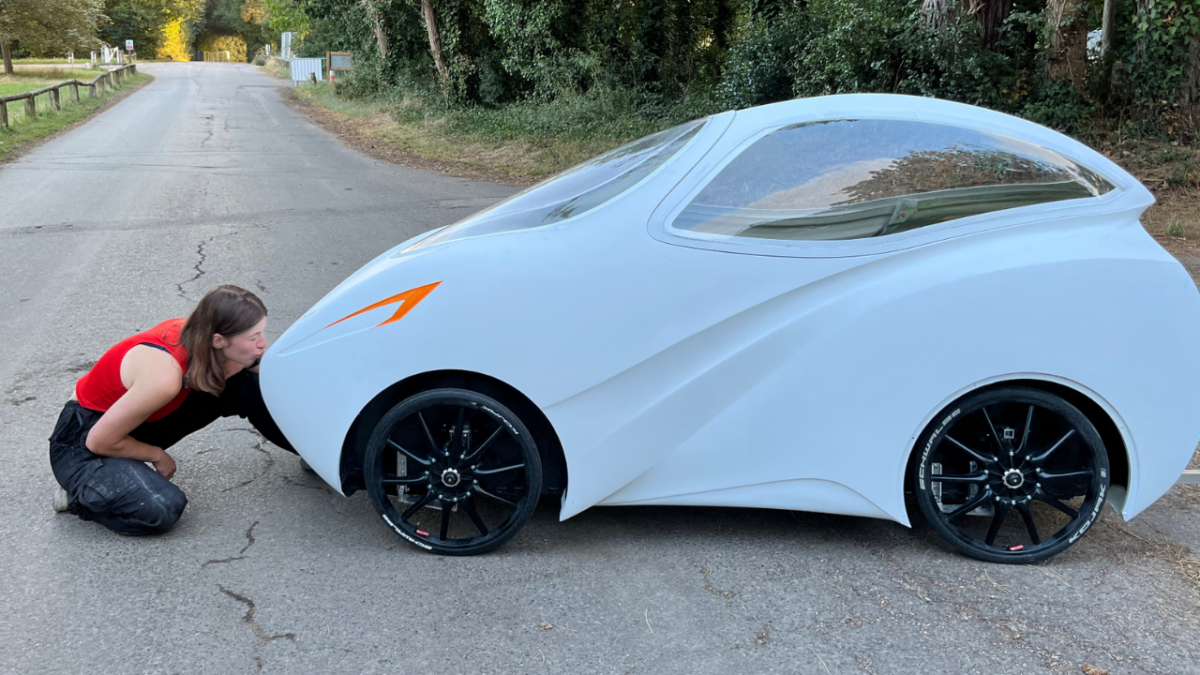
Sitting in Bicester traffic, the first spark of an idea took hold. Today, that idea has become the Elecy: a fully enclosed, four wheeled electric bike designed to lower the barriers that stop people choosing cycling in everyday life.
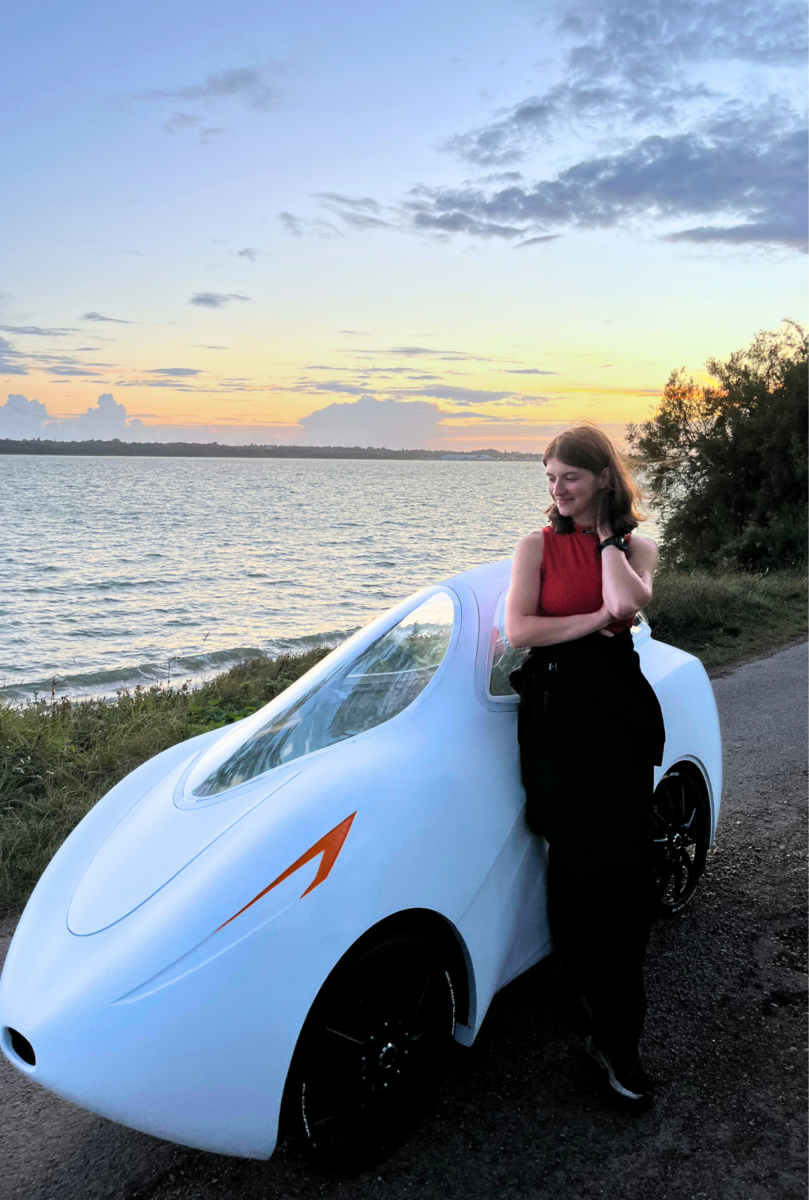
Built from recycled materials – each part designed to be repaired, upgraded or recycled – the Elecy offers weather protection, security and practicality without sacrificing the simplicity of cycling. It has recumbent seating for one adult and one child, fits within standard cycle lanes, is lockable, GPS tracked, and also has the space to take on board the weekly food shop.
In short, it has everything to do the job currently done by an electric car, but with 98 per cent fewer emissions.
Turning idea into action
Back at Southampton, Tamara set about turning concept into reality. She founded Amara Automotive, rolling up her sleeves to develop the Elecy into a viable vehicle.
Momentum followed quickly. In her final year, Tamara secured a grant from Innovate UK and was accepted onto Future Worlds’ 2023 cohort, Southampton’s startup accelerator. At the same time, she was running her business solo, completing her degree, and being an active member of the Human Powered Flying Society and the Formula Student team.
“It was hectic,” she admits.
But it was also transformative. Beyond office space, mentoring, and introductions, Future Worlds helped shift her mindset from pure engineering to real‑world problem‑solving.
“They taught me how to get out of my comfort zone and stop thinking like an engineer all the time,” Tamara says. “You have to approach running a commercial project very differently. Commercially you need to figure out what people need rather than what is perfect from a technical and performance point of view.”
Just as importantly, it offered community.
“Being a solo founder is a lot to handle. Having a hub where you can lean on and support other founders makes a difference. We’re trauma‑bound,” she laughs.
Refining the prototype
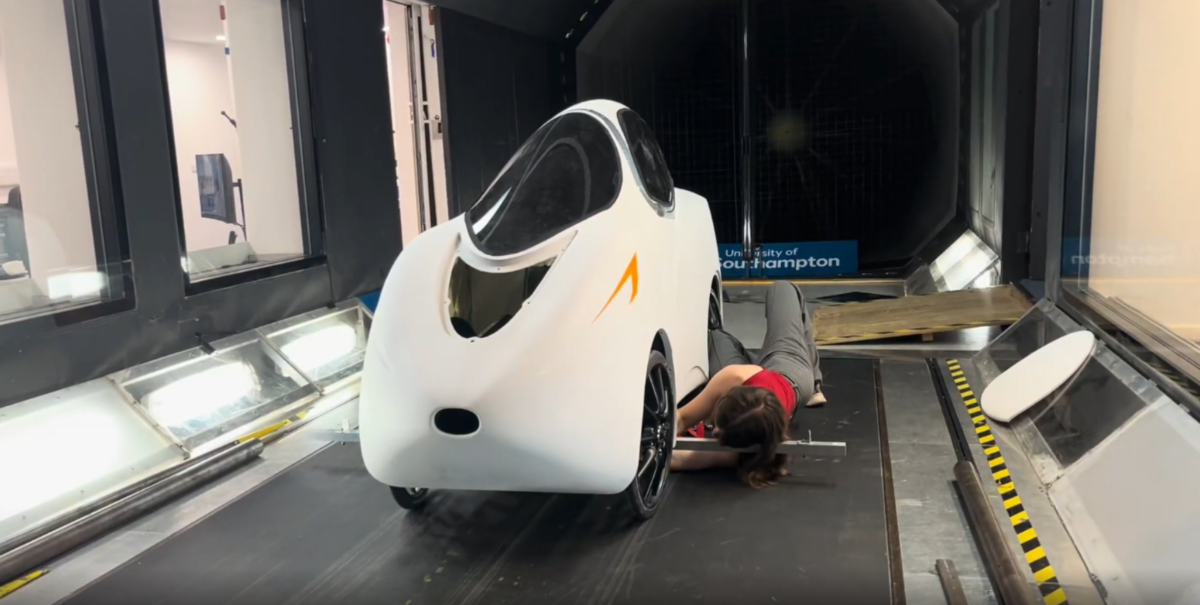
Southampton’s facilities played a critical role in shaping the Elecy itself. For her dissertation, Tamara built a scale model and tested it in the University’s wind tunnel.
“The Elecy offers higher efficiency than regular eBikes thanks to its low drag aerodynamics. However, at the speeds the Elecy travels, drag isn’t the biggest concern,” she explains. “The real challenge is rider cooling. Cyclists get hot, and in a fully enclosed vehicle, there is not much space for the heat to dissipate.”
Wind tunnel testing allowed her to experiment with ventilation, improving rider comfort and helping fine-tune the exterior design.
Tamara’s connection with the University continues today. Through the Student Enterprise and Employability Team, she’s accessing further grant support to fund internships – creating opportunities for current Southampton students to gain hands‑on experience.
“They’ve been fantastic,” she says.
Record breaker
Five years on from that first kernel of an idea, Tamara is confident she can build a fully functioning Elecy. The bigger challenge now is convincing more people to try something new.
Her response? Go big.
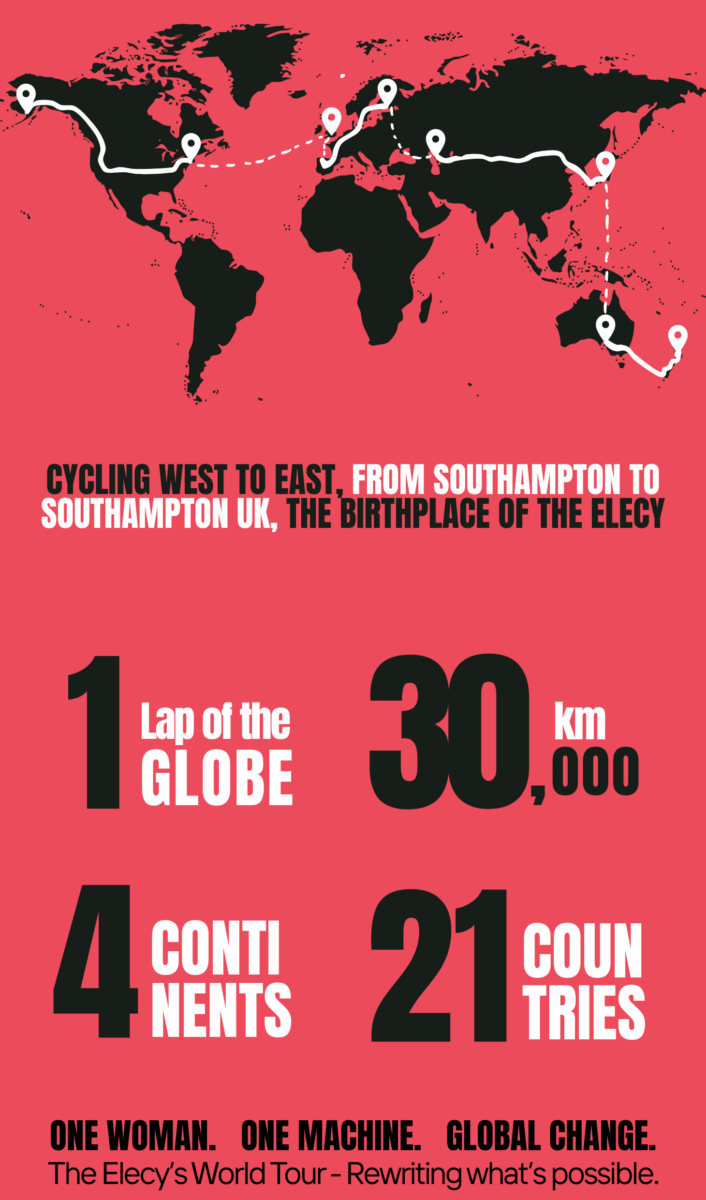
In 2026, Tamara will attempt a record‑breaking 30,000km cycle around the world, riding the Elecy across four continents and 23 countries.
The question she’s posing is disarmingly simple: If I can cycle around the world, surely you can cycle to the office?
The journey, launching in late June 2026 and expected to take 9-12 months, will act as a global testbed. Tamara plans to refine the vehicle as she travels, addressing real‑world challenges as they arise, and returning with a production‑ready prototype.
Along the way, the tour will double as a global campaign – fuelled by conferences, exhibitions, media moments and a potential documentary – to get more people out of cars and onto bikes.
Once completed, Tamara hopes to have notched up two Guinness World Records: the first solo circumnavigation by a quadricycle, and the first circumnavigation in a self-built vehicle. In order for that to happen, the journey must be over 29,500kms – the length of the Equator – and travel predominantly in one direction. “Crossing back on myself will not count, so given the various stops, I will end up doing way over 30,000km in total.”
A brighter future
Tamara is funding Amara Automotive herself, without outside investment. Financial support comes partly through Cova Concepts, her engineering consultancy, where she’s already designed a HydraJet made entirely from recycled carbon fibre.
“I have big plans,” she says. “I don’t want to be diluted out early.”
Those plans reach far beyond a single vehicle. The ultimate goal is to reach net zero in transport. While the Elecy remains central, Tamara now sees even wider potential in the recycled composite technologies she’s developing.
“We can build lighter, safer vehicles from waste material,” she explains. “If we get those technologies into the wider transport industry, the impact could be huge.” It’s an indirect route to net zero, but disrupting the industry in this way would be powerful.
The net zero target is rooted in reflection. From the age of 15, Tamara worked with high‑performance vehicles, including stints at Aston Martin, AlphaTauri and McLaren F1.
“At some point, I realised that making cars go faster around a circuit wasn’t fulfilling anymore,” she says. “I started asking what else I could do with my skills.”
That question, and the courage to follow it, has led her here.
If net‑zero transport is achieved, if every day cycling becomes easier and more inclusive, if waste materials become the building blocks of safer vehicles, then this won’t just be one alumna’s success story. We’ll all have something to celebrate.
Feeling inspired?
If you’re a recent University of Southampton graduate inspired by Tamara’s story, you can talk to Future Worlds about launching a startup, Student Enterprise about starting a business and the Social Impact Lab about founding a Social Enterprise.
If you feel you could spare some time and use your experience, insights and connections to assist the next generation of students to found world changing startups, businesses and social enterprises, find out more about Future Worlds startup founder mentoring here, and the University e-mentoring scheme, E-Mentoring Southampton.