Clothes that work harder – beyond the fashion statement
Within the E-textile Innovation Lab she established in 2020, Professor Kai Yang is stitching life-changing technology into everyday clothes. Empowering stroke, osteoarthritis, and injury patients to self-rehabilitate, rather than relying on others or mobility aids, Kai’s smart textiles are reconnecting patients to a sense of self and independence.
People who suffer strokes face long roads to recovery.
The only way to regain strength and mobility is to move – but this can feel almost impossible when movement is so fatiguing, or muscles are almost completely paralysed.
The UK’s five million osteoarthritis sufferers find themselves in a similar catch-22. The advice is to exercise more, but movement causes pain.
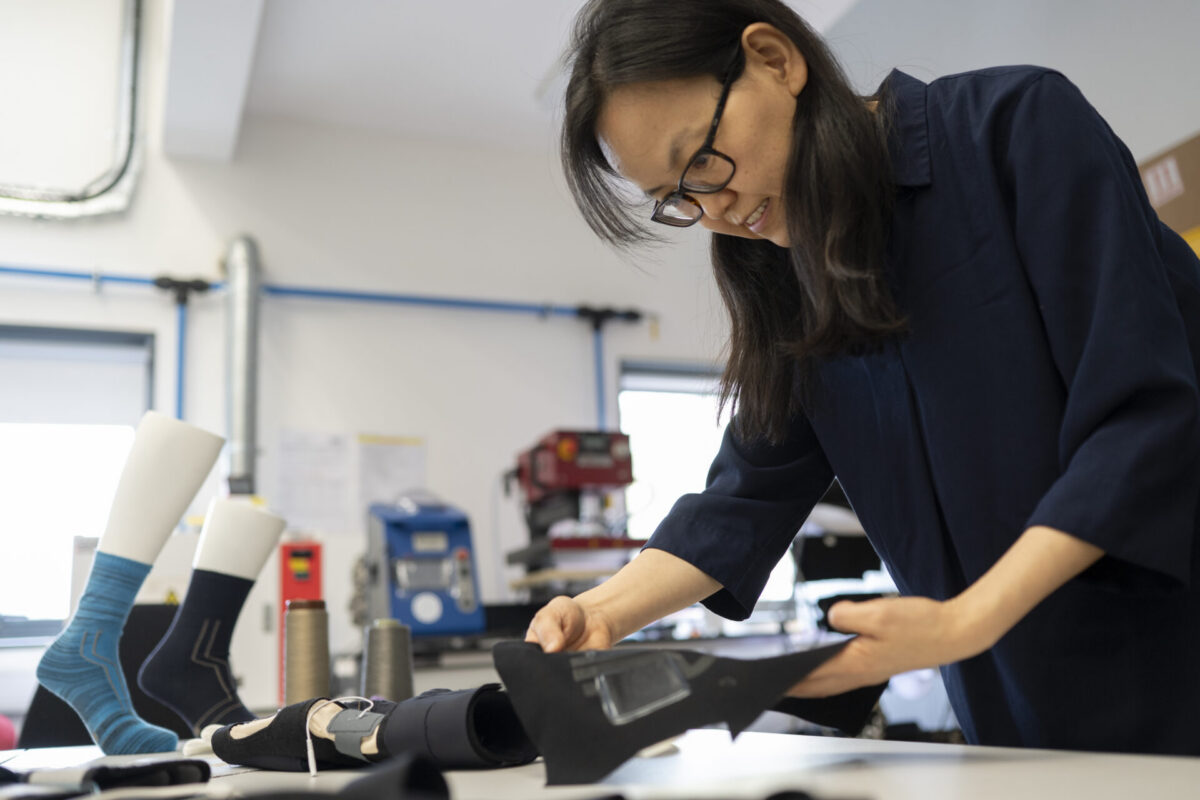
At the University of Southampton, electronics, sustainability, and textiles researchers have joined forces to create textiles that stimulate nerves and muscles.
Acting as alternatives to walking aids and mobility scooters, innovations like smart gloves and electronic sleeves can empower people to live more independently, move more freely, and manage their conditions from home.
Built differently
Growing up, Kai’s father sold custom-made furniture, tailored to his customers’ exacting requests. It sparked a lifelong interest in making lives better through entrepreneurship and custom design.
Kai spent 11 years working in Southampton’s Electronics and Computer Science (ECS), collaborating with electronic engineers and developing her research skills. She still works in close collaboration with her colleagues in ECS, as well as colleagues in Medicine and Health Sciences.
Drawing on this mix of disciplines, Kai began exploring how the electrical stimulation used in devices such as TENS machines could be built into textiles. Often used to manage pain during labour, their low-voltage electrical currents stimulate nerves and reduce pain perception. They can also trigger movement in paralysed muscles – helping build back function without placing further energy demands on the patient.
Simulating movement, stimulating growth
These e-textiles (electronics textiles) are knitted by bespoke industrial knitting machines in a dedicated lab, established by Kai in 2020.
With input from electronics experts, a state-of-the-art TENS machine with advanced stimulation programme has been developed that allows the patient to vary the stimulation level and time.
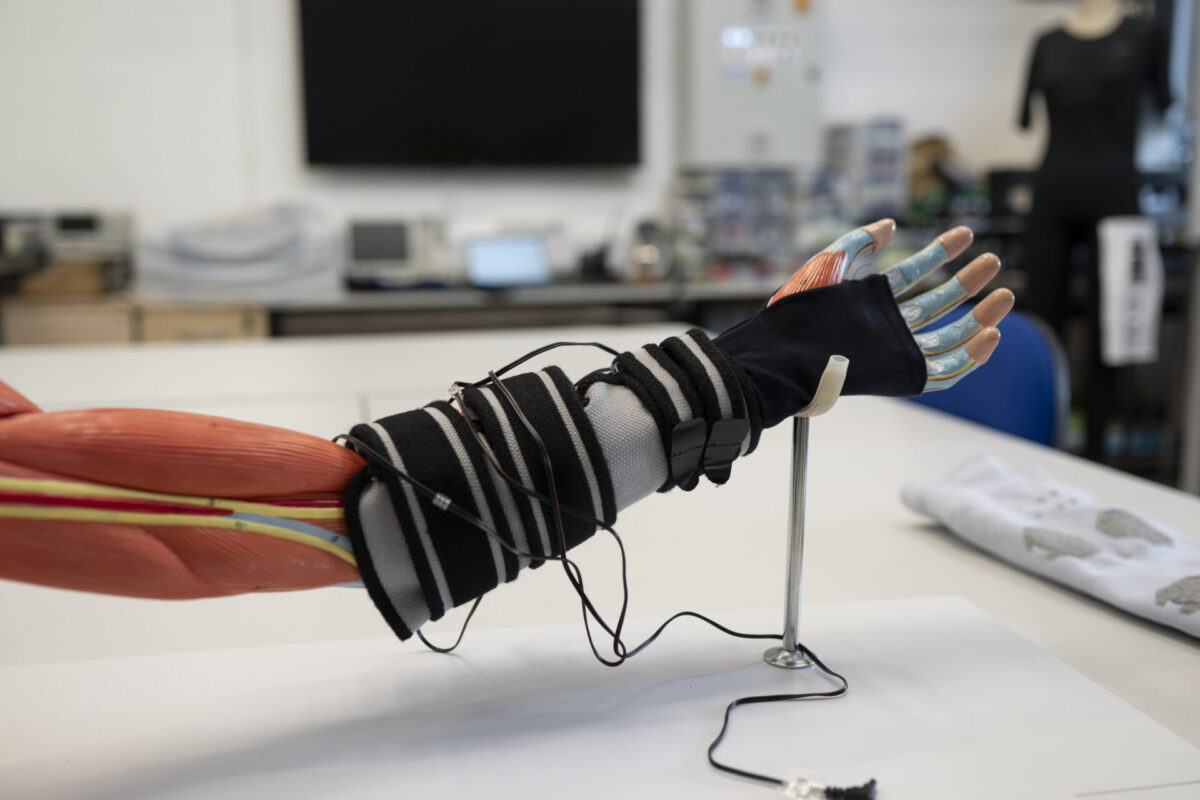
In a trial, two osteoarthritis sufferers commented the e-textile knee-sleeve allowed them to walk their dogs without pain or limping for the first time in years.
An early glove prototype tested with a stroke survivor through the charity Different Strokes was described by the patient as “life-changing”.
“It means I can move my hand – something I’ve been unable to do for eight years”, says stroke survivor Dave Lea.
And as Kai points out, it’s the human aspect of her work that’s most fulfilling, “Talking to people, identifying a problem my technology could fix, and bringing a team together to change their lives. We have the perfect mix of expertise, manufacturing capabilities, and freedom to push the boundaries of the technology.”
Close-knit teams
Kai’s work contributed to the £10 million, five-year SUSTAIN project that brings researchers from multiple faculties from two universities together to make e-textiles wireless, imperceptible, and sustainable.
As with anything designed for medical use, there are many levels of testing and approvals. The University’s interdisciplinary culture, fuelled by projects like SUSTAIN, provides a ’right person, right place’ environment, where there’s someone present to cover everything from safety to biocompatibility to sustainability, avoiding new garment types don’t end up in landfill.
On the long road to commercialisation, the lab helps answer key questions about certification, manufacturing, scalability, and cost-effectiveness – accelerating breakthroughs and getting innovations into the hands of the people who need them most.
The future of wearable electronics
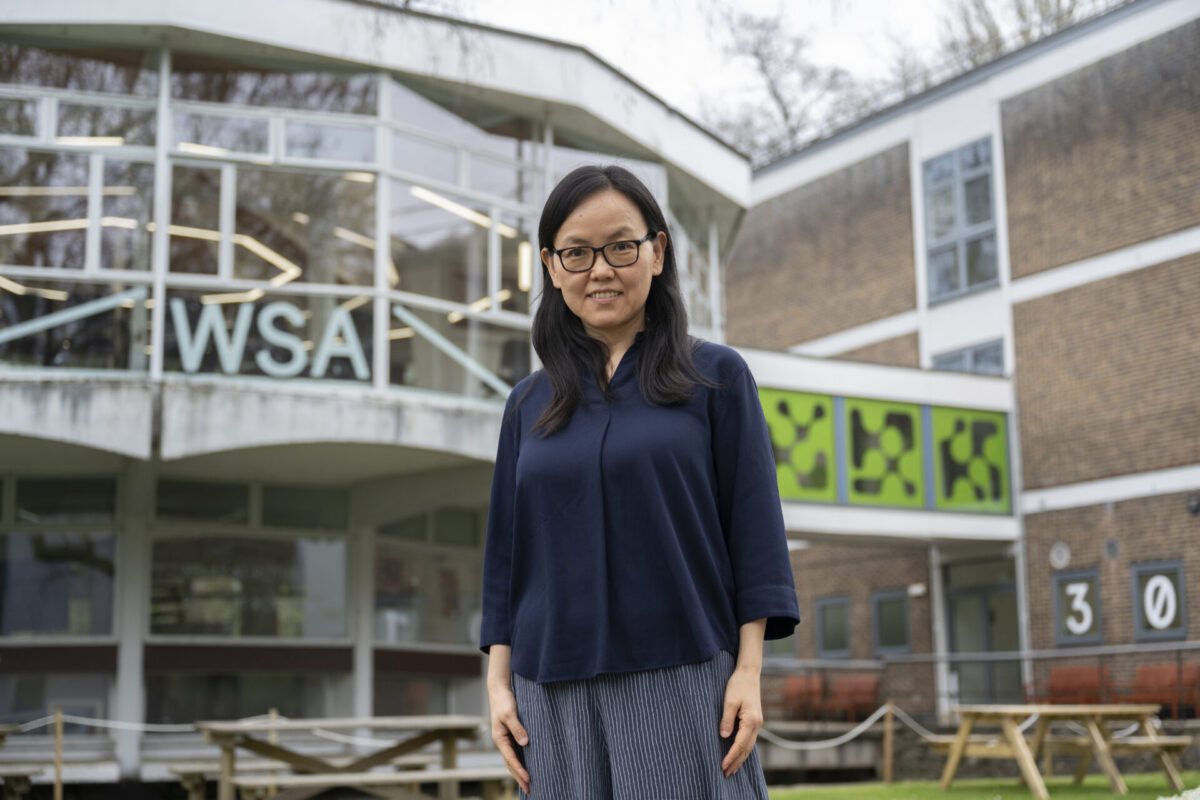
Kai believes the future of e-textiles is wearable technology that looks no different to normal clothes.
“People don’t want to be labelled as disabled; they want to be seen as a person. The stigma associated with traditional medical devices could be overcome with functional textiles that look just like normal clothing items. Our big focus is co-design with end users for comfort, ease of use, and aesthetic.”
Kai adds, “Testing, trying, failing, changing something, and trying again is what gets me up in the morning. I keep doing it because the end game is transforming someone’s life.”
Kai’s work is one example of how Southampton research is bringing together expertise from across the University to transform lives.